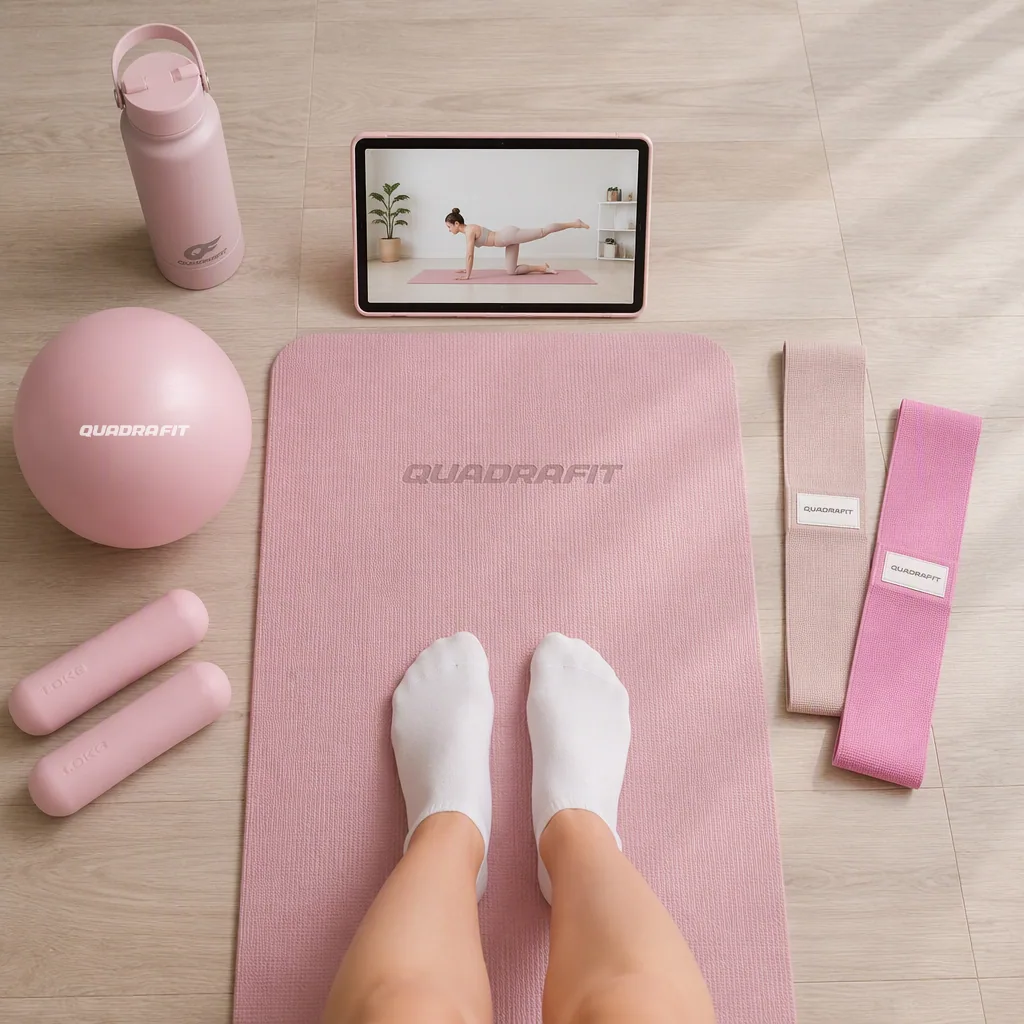
A six millimetre mat feels generous under the knees and uncertain under the standing foot, and that contradiction is not a matter of taste. Thickness changes how load travels from the floor into the ankle, how far the surface deforms before it pushes back, and how much information the sole of the foot receives. For a studio buying in volume or a brand building a range, thickness is the one dimension that decides whether a mat is read as stable or as soft.
Why a softer surface makes standing balance harder
Standing balance is a loop: the sole of the foot senses pressure, the ankle corrects, the hip stabilises. A compliant surface slows that loop down. The foam compresses under the metatarsal heads and the heel, the foot sinks into a shallow bowl, and the ankle has to generate a larger correction for the same amount of sway. The taller the foam column, the longer the delay between a wobble and the correction that answers it.
Surface compliance is measurable, not anecdotal. In a study from Baylor College of Medicine that ran the modified Romberg test on a medium foam and on a medium-firm foam, healthy older controls and patients with vestibular disorders produced different trial durations and different numbers of head movements on the two foams, and the authors concluded that foam density alone shifts the score (Biomedicine Hub, 2020). If a change of foam density is enough to move a clinical balance score, the same change is enough to move a student's confidence in Vrikshasana.
What each thickness band does in a standing pose
- 1.5 to 3 mm: minimal compression, direct floor feedback, the steadiest base for one-legged work, and unforgiving under knees and wrists.
- 4 to 5 mm: the working compromise for most studios, enough foam to soften the floor and little enough to keep the ankle quick.
- 6 mm: comfortable in seated and supine sequences, noticeably slower to settle in standing poses, and the band where balance complaints usually begin.
- 8 mm and above: chosen for restorative work, kneeling and sensitive joints, with visible edge roll once the stance widens.
Joint support comes from density as much as from thickness
Two 6 mm mats can behave like two different products. A closed-cell TPE at roughly 0.12 to 0.15 g/cm3 compresses early and bottoms out under an 80 kg load, while a natural rubber sheet at a higher density and a 5 mm caliper reading resists compression further and returns faster. What protects a wrist in Plank or a knee in Virasana is the load at which the foam stops compressing, not the number printed on the label. Ask for the compression set after 22 hours at 70 degrees Celsius and the indentation load at 25 per cent deflection, and a supplier can describe how the sheet will feel in month six rather than on the day it is unpacked.
Matching thickness to pose family, height and footprint
A 165 cm student on a 173 cm mat stands with the heel at the edge in a long stance; a 190 cm student on the same mat steps onto the floor. Length first, then thickness: 183 x 61 cm and 183 x 66 cm cover most of the market, 200 x 68 cm serves taller users and wide-limbed practice, and the cut length can be set per order rather than per catalogue. Thickness should follow the dominant pose family. A vinyasa studio wants 4 to 5 mm, a yin and restorative programme wants 6 to 8 mm, and a hot room wants 4 mm with a porous top instead of a thick closed-cell block that holds sweat under the standing foot.
The full thickness and length matrix sits on the custom yoga mat range, and the pose-family breakdown is covered in more detail on the blog.
Specifying thickness that holds up in production and in the studio
Thickness on a purchase order needs a tolerance, a measurement method and a list of test points. A workable specification reads: 6.0 mm plus or minus 0.3 mm, measured with a digital caliper at five points along the length and across the width, after 24 hours of conditioning at 23 degrees Celsius, with no point under 5.6 mm. Add a roll-recovery check, because a mat that stays curled at the head end will be read as a balance problem by the user even when the caliper says the thickness is correct: roll the mat to 100 mm diameter, hold for 72 hours, release, and record the time to lie flat.
Batch records should carry the caliper readings, the foam lot, the density and the compression set, so a complaint about uncertain mats can be traced to a lot instead of argued case by case. Send the target pose families, the user height range and the tolerance to our specification desk and a sheet can be quoted against a measurable thickness rather than a nominal one.
Frequently asked questions
Is a 6 mm mat too thick for balance work?
For most standing balance poses it is at the limit. At 6 mm the foam starts to slow the ankle correction, so keep that band for seated, supine and restorative work and choose 4 to 5 mm for one-legged standing sequences.
What is the standard yoga mat size?
183 x 61 cm is the most common footprint. 183 x 66 cm and 200 x 68 cm serve wider and taller users, and length should be matched to height before thickness is chosen.
Can mats be produced in custom lengths?
Yes. Length is a cut dimension, so 173, 183, 200 and 210 cm can run on the same line while thickness is held to a 0.3 mm tolerance and the width stays fixed.
Does a thicker mat protect knees better?
Only up to the load where the foam stops compressing. A denser 5 mm sheet can support a knee in Virasana better than a soft 8 mm one, so specify density and compression set, not thickness alone.