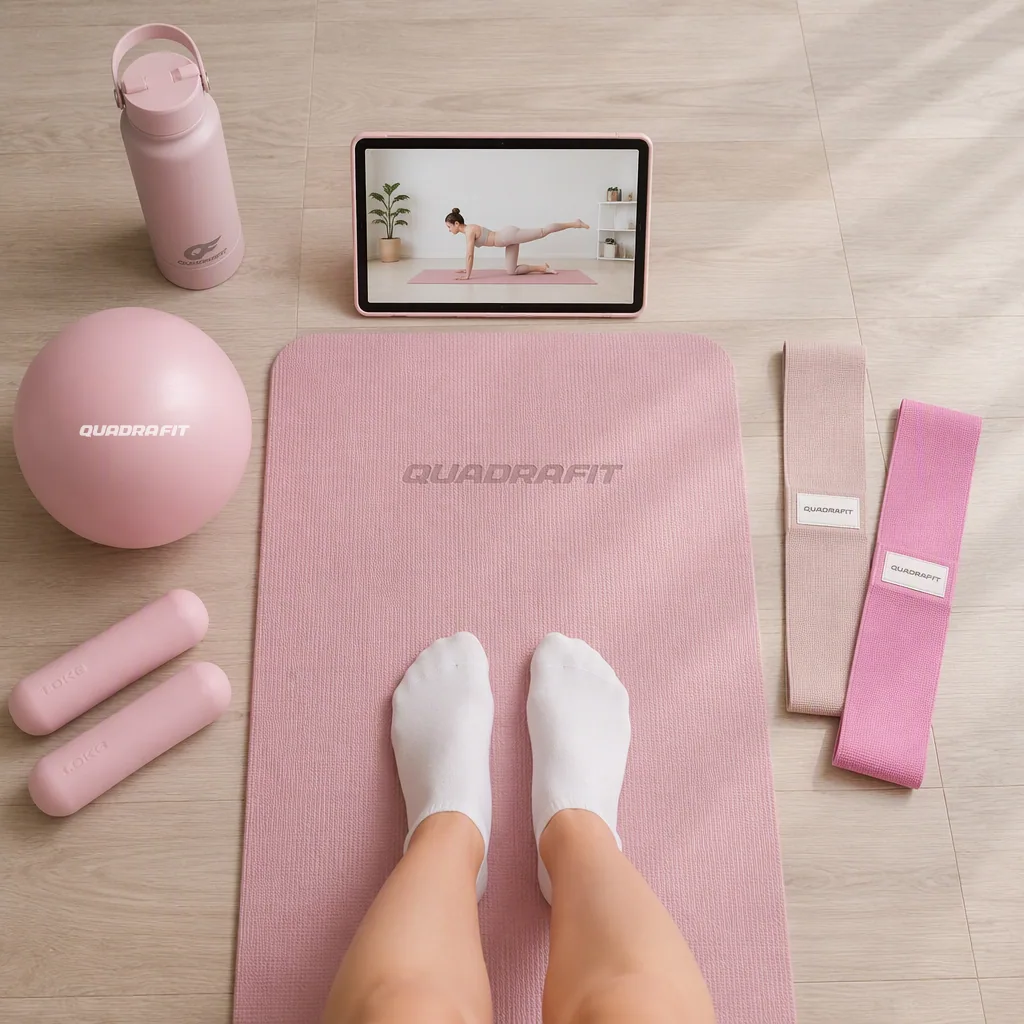
A mat that travels well is a mat with two numbers under control: the diameter of the roll and the mass that hangs from the shoulder. Thickness feeds both, and it feeds them at different rates, which is why a jump from 4 mm to 8 mm never feels like the doubling it actually is.
Two numbers decide whether a mat travels well
Rolled diameter decides whether the mat fits a tote, a locker, a bicycle frame or an overhead bin. Mass decides whether the user carries it or leaves it at home. Both grow with thickness, but one grows with the square root of thickness and the other grows in direct proportion. That difference is what turns a vague request for a lighter mat into a specification a factory can hold.
Rolled diameter grows with the square root of thickness
Roll a sheet into a spiral and the cross-section of the roll equals the length multiplied by the thickness: 3.14 x D squared divided by 4 equals t x L. For a 183 cm mat, a 4 mm sheet rolls to about 9.7 cm, a 6 mm sheet to about 11.8 cm, and an 8 mm sheet to about 13.7 cm. Doubling thickness from 4 mm to 8 mm therefore raises diameter by roughly 41 per cent, while the packed volume and the weight both double. A thick mat takes more space than it appears to deserve and weighs exactly what the material says it will.
What the same thickness weighs in TPE, PVC, natural rubber and jute
At 183 x 61 cm, a 6 mm closed-cell TPE mat usually lands near 1.2 to 1.4 kg, a 5 mm natural rubber mat near 2.3 to 2.6 kg, a jute-faced PVC mat near 2.0 to 2.4 kg, and an 8 mm NBR mat near 2.2 to 2.6 kg. Material is often the bigger lever than caliper: moving from a 5 mm natural rubber sheet to a 5 mm TPE sheet removes close to a kilogram from the shoulder, and a 1.5 mm travel sheet can sit under 0.9 kg.
Where carry limits actually bite
Airline cabin limits are the hardest constraint most travelling practitioners meet. IATA publishes common carry-on dimensions of 56 x 45 x 25 cm, notes that some carriers apply weight limits starting at 5 kg, and recommends that individual checked bags stay at or under 23 kg (IATA passenger baggage rules). A 68 cm wide mat does not fit inside a 56 cm cabin length, so it travels diagonally or in a longer duffel, and a 12 cm roll plus a strap and a change of clothes can consume much of a 5 kg allowance. Courier tiers behave in the same way: the first weight band often ends at 1 kg or 2 kg per parcel, which decides whether a mat ships as a single parcel or shares a carton with other stock.
Choosing the compromise by user and specifying it for production
Daily commuters on public transport are best served by 4 mm at 183 x 61 cm with a strap; studio members who drive want 5 to 6 mm and a bag with a shoulder strap; restorative and prenatal users need 8 mm and accept the bulk; hot yoga needs 4 mm with a moisture-tolerant top. A retail range can cover all four with two thicknesses and two lengths if density is specified per SKU. Set weight per piece with a tolerance of plus or minus 5 per cent, state the rolled diameter target (for example 118 mm plus or minus 5 mm at 6 mm), declare whether the strap or core is included in the piece weight, and fix the compression set so that a light mat does not become a thin mat after a season of use.
The weight and size matrix by material is on the product pages, the way density is chosen for each material sits on the about page, and a joint decision on thickness, length and carry hardware can be run against a target parcel weight through the contact desk.
Frequently asked questions
How much does a standard mat weigh?
A 183 x 61 cm mat in TPE at 4 to 6 mm sits near 1.0 to 1.4 kg. The same footprint in 5 mm natural rubber is closer to 2.4 kg, so material matters as much as thickness.
Can a mat be light and still cushioned?
Yes, by lowering density rather than thickness, but the compression set has to be checked. A low-density 6 mm sheet can bottom out under a heavy user within a few months.
What weight is too heavy to carry?
Above roughly 2.5 kg a daily commute on public transport becomes a chore, and above 3 kg most users keep the mat at the studio instead of carrying it.
Does a thinner mat always roll smaller?
Diameter falls with the square root of thickness, so halving 8 mm to 4 mm cuts diameter by about 29 per cent while halving both packed volume and weight.